

ABOUT
What happens to us as humans—our shared humanity—living in algorithmic societies?
This question lies at the heart of Danish artist Cecilie Waagner Falkenstrøm’s current research project. Leading the art and technology studio ARTificial Mind (founded in 2016 in Copenhagen, Denmark), Falkenstrøm joins the MSUFCU Arts Power Up Artist-in-Residency program at Michigan State University, commencing in fall 2025. This program embeds artists in the university’s campus with the aim of fostering interdisciplinary collaboration, exploration, experimentation, and innovation, culminating in the creation of groundbreaking artworks at the intersection of art, science, and technology. The program provides a supportive environment for artists to create new artworks while engaging with our vibrant communities across this top global, proudly public research university. The MSUFCU Arts Power Up Residency is grounded in the question: How can artistic research expand the ways we think about and engage with the world around us?
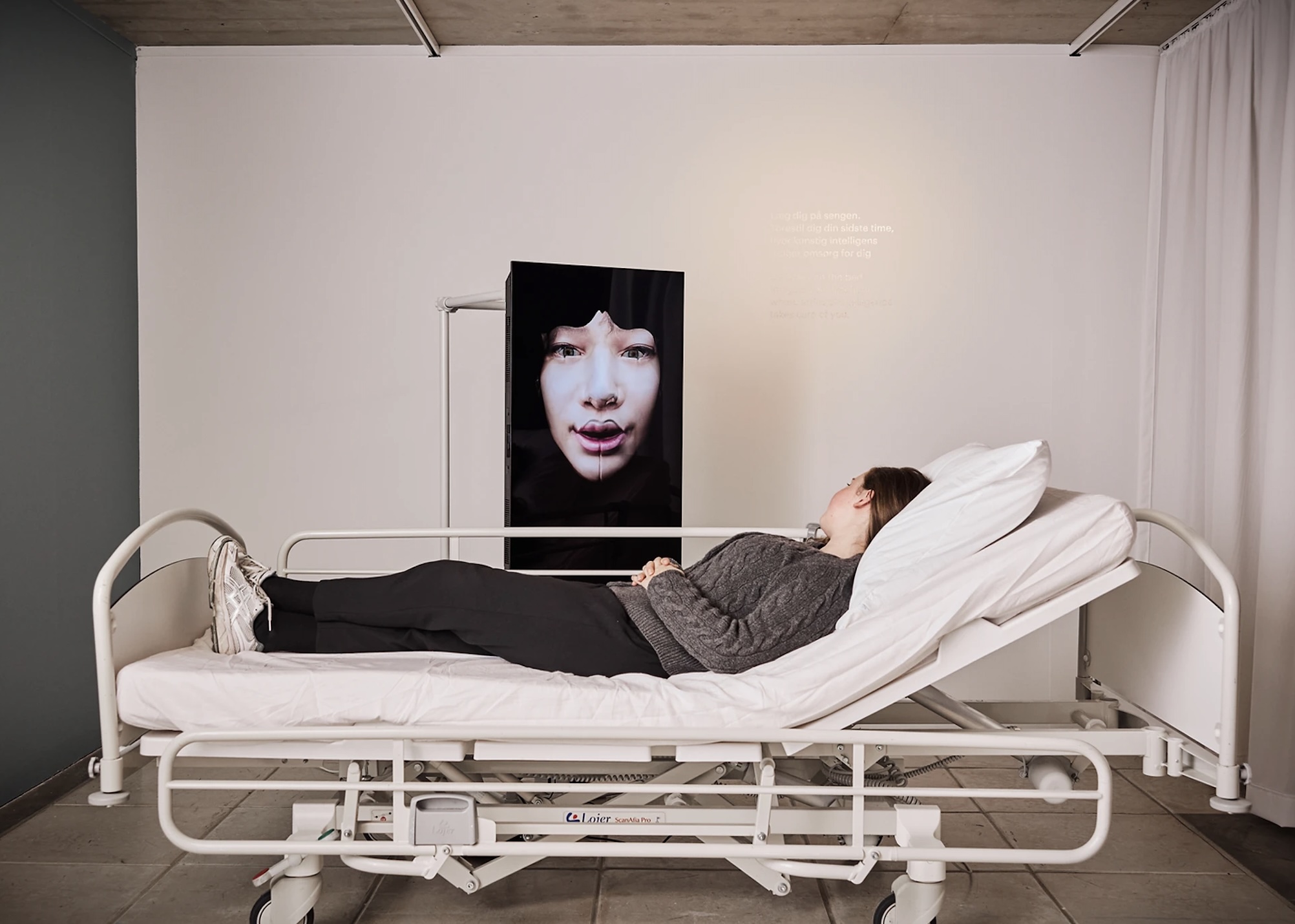
This iteration of the residency will result in a new, gallery-sized installation titled Synthetic Sirens, developed out of generative machine-learning models and artificial intelligence (AI) programs. The residency and exhibition are co-creative endeavors, developed out of the artist’s engagements with faculty, staff, researchers, and students at the university. Working together, and with a wide range of inputs, the participants focus their explorations on issues of health and well-being in the age of AI. As inspiration for the residency, Falkenstrøm asks, “How do AI algorithms in social media not only shape our public personas but also reconfigure the private spaces of thought and conscience. What does it mean to live with algorithms that not only influence what we see but also how we feel about ourselves? What do we lose when AI patterns replace physical presence?”
Synthetic Sirens is interactive in nature, intended to be a participatory dialogue with visitors. Importantly, the process of engaging with the new work will further catalyze the development of the artwork itself. Seizing on the true generative nature of machine-learning and the residency model, the artwork and exhibition will evolve over time through deeper engagement and interaction with collaborators and visitors, alike. The very idea of learning—together, and with machines—is at the core of this project and ultimately will reveal both the limits of, and opportunities within, our ever-changing, algorithmic societies.
Synthetic Sirens is organized by the Eli and Edythe Broad Art Museum at Michigan State University and co-curated by Maral Zakharia, associate professor in the MSU College of Communication Arts and Sciences, and Steven L. Bridges, senior curator and director of curatorial affairs at the MSU Broad Art Museum. Support for this series is provided by the Michigan State University Federal Credit Union. The exhibition is the result of the MSUFCU Arts Power Up Artist-in-Residency program, which is also generously supported by an endowed gift from Michigan State University Federal Credit Union. This iteration of the program developed out of a partnership between Arts MSU, MSU College of Communication Arts and Sciences, MSU Broad Art Museum, and the MSU Ethics Institute.